
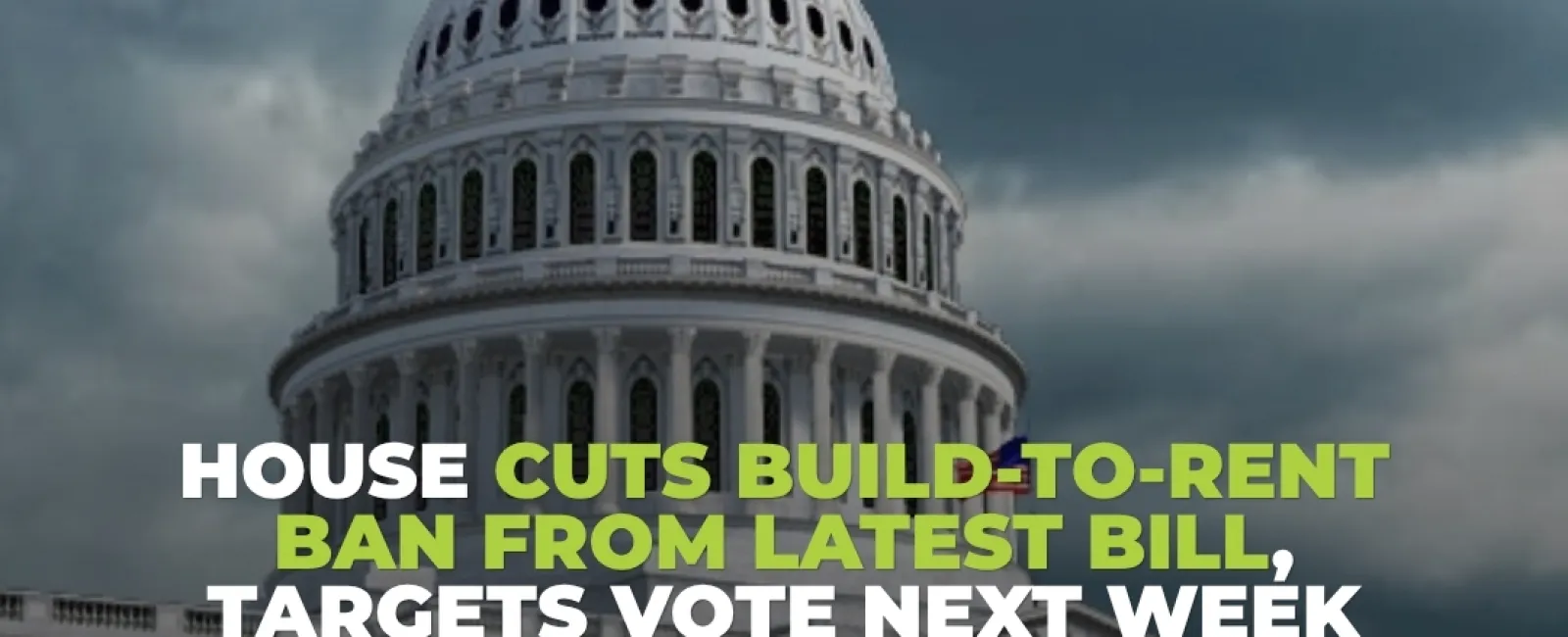
After weeks of negotiations and industry pushback, House lawmakers have removed controversial build-to-rent (BTR) restrictions from the amended 21st Century Road to Housing Act, a move that could significantly impact the future of institutional investment in single-family rental housing.
The revised legislation, released late Wednesday by senior House leaders, strips out provisions that would have required BTR operators to sell properties after seven years of ownership. The updated bill also eliminates proposed caps on portfolio holdings, easing concerns that the earlier version would effectively disrupt the BTR business model.
House leadership is now aiming to move the bill forward with bipartisan backing through a suspension vote next week, a process requiring a two-thirds majority for passage. If approved, the legislation will return to the Senate for final consideration.
The original restrictions were introduced in the Senate version of the bill earlier this year, triggering strong opposition from both BTR operators and affordable housing advocates. Critics argued the measures would reduce housing supply and discourage new development at a time when rental demand remains elevated nationwide.
The amended legislation still places some limits on large institutional investors, defined as firms owning at least 350 homes, from purchasing certain existing single-family properties. However, lawmakers narrowed the definition of qualifying homes and introduced several exemptions that preserve a wide range of investment activity.
Under the updated language, properties that have consistently operated as rentals, manufactured housing, and homes requiring rehabilitation are exempt from the acquisition restrictions. The bill also removed a prior requirement mandating investors spend at least 15% of a home's purchase price on renovations.
Most notably, the revised bill explicitly states that institutional owners will not be forced to divest properties already acquired, providing additional certainty for large operators active in the sector.
The debate around the legislation has already affected activity within the BTR market, slowing some lending and acquisition efforts in recent months. Even so, major operators continue signaling long-term confidence in the sector. Invitation Homes and AMH, two of the largest BTR companies in the country, spent a combined $554 million on stock buybacks during the first quarter while authorizing an additional $1.2 billion in future repurchases.
The BTR sector has experienced rapid expansion since the pandemic, with rental-home construction increasing 455% between 2019 and 2024. Rental homes accounted for more than 7% of all housing starts in the year ending in September, highlighting continued demand for professionally managed single-family rental communities.
At Ever Resi Media, we continue monitoring the latest legislative developments, housing policy changes, and investment trends shaping the residential real estate industry. By staying current on both market activity and policy shifts, we aim to deliver timely insights that help readers better understand the evolving housing landscape.


